Posts mit dem Label says werden angezeigt. Alle Posts anzeigen

Samstag, 27. Februar 2016

The wealthier you are, the more you chase well-being, says survey

A recent survey on women’s health across five countries, including India, has confirmed what we’ve known all along: that wealth and well-being go hand in hand. It reports that 98% of those who are financially secure claim to actively pursue a sense of well-being compared to the 65% in lower income groups. The study titled ‘Women’s health and wellbeing: Evolving definitions and practices’ covered 453 women and 100 public officials across India, Brazil, Mexico, France and Germany.


The recently released survey was sponsored by the consumer health division of pharmaceutical company Merck and conducted by the Economist Intelligence Unit. The project looked specifically at women’s responses to goals on health and wellbeing. The notion of wellbeing included factors other than physical health —work-life balance, education and skills, income, social connections, civil engagement, personal security, housing, environmental quality and subjective wellbeing. (By dint of its method of data-collection —via online questionnaires — the survey preselects a middleand-higher-class sample, at least in the Indian context.)


In an attempt to extend the horizons of personal health to holistic well-being (a Sustainable Development Goal), the survey tried to understand what ‘wellbeing’ meant to women across cultures and socioeconomic backgrounds. To 64% of the respondents, wellbeing was associated with feeling healthy and physically fit, a correlation made by 74% of public officials who work on government programmes aimed at women’s health and well-being. They conflated lack of illness with wellness, discounting social or psychological pressures as inhibitors to holistic health.


Then again 23% said ‘feeling well’ was feeling optimistic about their own future as well as that of their family, an association made by only 3% of public officials. This mismatch between the perception of women and policy-makers around wellness suggests how health policies can be better calibrated.


The survey revealed a further incongruity between the kind of health programmes desired by women, and what was officially on offer: 48% said they’d like programmes related to hobbies and cultural activities, but 73% of health officials rooted for illness prevention programmes. “Women are often the caretakers of their families and educate them on health and wellbeing,” said Uta Kemmerich-Keil, CEO of Merck’s consumer health business. “They also represent the majority of professionals in health care occupations, so they have the broadest impact on improving health and well-being in our societies.”


The survey showed that women in India (95%) and Brazil (86%) claimed to be most active in trying to ensure asense of personal well-being. They defined well-being as the avoidance of unhealthy activities like smoking or drinking, rather than a proactive commitment to exercise or a healthy diet. The survey also found a gap between women’s stated practice of healthy living and the actual fact: Brazilian women spent more heavily on beauty products and treatments than on their health, showing that beauty overrode health. Wellbeing apparently includes building and maintaining good family relations, vital to emotional stability.


However, Sanghita Bhattarcharya, senior public health specialist at the Public Health Foundation of India — a participant in EIU’s interview programme — pointed out that beyond a narrow elite, there’s little hope about Indian women actively managing their wellbeing. “Public health policy has paid little attention to the wellbeing of women beyond their reproductive years,” she said. “This in itself is a manifestation of gendered expectations, where even decision-makers have not looked at women beyond their roles as mothers and care-givers.”


(The author was in Germany at the invitation of Merck)


The wealthier you are, the more you chase well-being, says survey

Mittwoch, 23. Dezember 2015

Middle schools: More birth control training, says CDC


The United States Center for Disease Control (CDC) announced that more young teens attending middle schools need to be trained how to use a slew of contraceptives, including condoms, abortifacients and other modes of artificial birth control.


A Closer LookThe government agency also stressed that middle school teenagers need to be taught “necessary skills” so that they won’t contract a plethora of sexually transmitted diseases, such as HIV and herpes. In its report, the CDC also said in its report that the “preventative measures” American middle schoolers must learn are to avoid unplanned pregnancies.


The results of CDC’s latest survey of American middle schools and high schools — administered once every other year — were published Wednesday to divulge the evolving health behaviors of students. Its 2014 School Health Profiles Survey findings were presented last week at the National HIV Prevention Conference, prompting the CDC to press for more aggressive sex education programs.


According to a CDC press release, students’ sex ed training in schools is not up to par.


“[F]ewer than half of high schools and only a fifth of middle schools teach all 16 topics recommended by … [the CDC] as essential components of sexual health education,” the government agency reported.


Some of the topics covered include the importance of using “condoms consistently and correctly,” the “benefits of being sexually abstinent,” the “importance of limiting the number of sexual partners,” and using condoms “at the same time as another … [kind of] contraception.” The CDC also states that 6th graders through high school seniors must also receive training about how to get condoms, “how HIV and other STDs are transmitted,” the “efficacy of condoms,” “how to correctly use condoms,” and the health consequences of HIV, other STDs and pregnancy.”


Sex ed. the CDC’s way


Included in the CDC study is the examination of the percentage of schools that are taught each of the recommended areas of sexual education, LifeSiteNews.com reports. It also discloses the median of each state before providing its national assessment of teen behavior.


“A median of 75 percent of schools taught ‘[h]ow to create and sustain healthy and respectful relationships,’ while education on how HIV and other STDs are transmitted and ‘health consequences of HIV, other STDs, and pregnancy’ were taught 75 percent of the time,” LifeSiteNews’ Dustin Siggins points out. “Schools least often taught ‘how to obtain’ and ‘how to correctly use’ condoms, at 27 percent and 23 percent. Seventeen percent of middle schools taught all 16 recommended aspects of sexual education.”


Ranked number one on the list is STD prevention, with 95 percent of middle and high schools instructing their students on “how HIV and other STDs are transmitted,” as well as about the “health consequences of HIV and other STDs and pregnancy.” A close number two was abstinence, which registered at 94 percent. For high schools, the lowest two on the CDC’s recommended list of 16 were “how to obtain condoms,” (60 percent trained students on this) and “how to correctly use a condom” (54 percent of high schools). Nearly half (46 percent) of high schools in America teach each of the  CDC’s 16 recommended aspects of sex ed.


Honing in on public school education on seven specific contraceptives, the CDC obtained information on IUDs and several other forms of birth control that can also be used as abortifacients by teenage students.


“Sixty-six percent taught how to ‘the pill,’ 61 percent the ‘patch,’ 58 percent the ‘ring,’ 61 percent the ‘shot,’ 55 percent implants, 60 percent the IUD, and 49 percent emergency contraception,” the CDC divulged, according to LifeSiteNews.com. “Forty-three percent of schools taught all seven methods of birth control. Nineteen large urban communities were also sampled, though New York City was notably excluded. While the urban communities’ median numbers were often within five percent of the national median, both middle schools and high schools were far more likely to teach students about condoms.”


More exposure?


CDC National Center for HIV/AIDS, Viral Hepatitis, STD, and Tuberculosis Prevention Director Jonathan Mermin stated that public schools must be more aggressive in its training of American teenage students.


“We need to do a better job of giving our young people the skills and knowledge they need to protect their own health,” Mermin insisted in his CDC press release. “It’s important to teach students about healthy relationships and how to reduce sexual risk before they start to have sex.”


Also noted in the press release is how condoms and other artificial birth control methods, devices, and drugs such as abortifacients are “essential topics in HIV, STDs, pregnancy prevention, and other health subjects.” The CDC called these classroom discussions “age-appropriate topics for middle and high schools based on the scientific evidence for what helps young people avoid risk.”


Even though a CDC media spokesperson would not tell LifeSiteNews whether it suggests educating students about the side effects of contraception or how numerous contraceptives can act as abortifacients, confirmation was given that it supports the public schools’ greater role in training kids to make “educated” sexual choices.


“CDC does not recommend the selection of a specific curriculum, but recognizes the authority of local school districts to make sexual health education curriculum decisions,” the spokesperson told LifeSiteNews. “CDC emphasizes that all sexual health education should be medically accurate and consistent with scientific evidence.”


The CDC also suggested that its brand of sexual morality should be inculcated in students to bring about what it considers society’s good, giving what many consider to be lip service about trying to accommodate local mores.


“[Sex education] should allow students to develop and demonstrate developmentally appropriate sexual health-related knowledge, attitudes, skills, and practices,” CDC continued. “It should also be consistent with community values, and developed with the active involvement of parents. What is critical is that our students get age-appropriate instruction across key areas of sexual health in both middle and high school in order to develop the skills they need to be healthy in adulthood.”


We moderate all reader comments, usually within 24 hours of posting (longer on weekends). Please limit your comment to 300 words or less and ensure it addresses the article. Comments that contain a link (URL), an inordinate number of words in ALL CAPS, rude remarks directed at other readers, or profanity/vulgarity will not be approved.


Middle schools: More birth control training, says CDC

Donnerstag, 3. Dezember 2015

UN says women's health treated as “afterthought” following humanitarian crises

A new report by the UN population fund (UNPFA) claims that in the humanitarian response to crises, women’s health is too often treated as an afterthought, “leaving already disadvantaged women and girls in an even more precarious situation,” with a lack of pregnancy, childbirth and family planning services. The report, titled “Shelter from the Story,” claims the humanitarian response should take into account the different impact conflict and disasters have on both genders. “In the tumultuous early phase of a crisis, food, shelter and care for acute physical trauma often seem the most compelling needs, with gender or any other kind of discrimination something that can be put off for a safer day. Thinking this way, however, can make a response blind to realities,” the report claims.


That’s why the UNFPA argues that putting women and girls’ health at the center of any humanitarian response is critical to its success. Because women generally have less income, less access to land and less education, and are not equally protected under the law, they are disproportionately ill-equipped to weather such a crisis. The fund estimates that some 60 per cent of all preventable maternal deaths (500 deaths every day) occur in humanitarian and conflict settings. Moreover, gender-based violence soars during and after a crisis, with rape often used as a weapon of war, and women becoming more vulnerable to trafficking. “For the pregnant woman who is about to deliver, or the adolescent girl who survived sexual violence, life-saving services are as vital as water, food and shelter.” said UNFPA’s executive director, Babatunde Osotimehin. “Having the means to prevent a pregnancy and being safe from sexual violence – these are basic human rights. Rights don’t just go away, and women don’t stop giving birth when a conflict breaks out or disaster strikes.”


Read the full story at The Guardian.


UN says women"s health treated as “afterthought” following humanitarian crises

Freitag, 4. September 2015

Anti-abortion leader says Texas funding women's health services at historically high levels

At a Texas Capitol rally, an anti-abortion advocate suggested Texas has hit a record pace in funding women’s health.


Video of the July 2015 rally shows Joe Pojman of the Texas Alliance for Life initially saluting Republican leaders for launching investigations in reaction to stealth videos showing Planned Parenthood employees talking rather casually about donations of fetal tissue. The videos had been circulated by the California-based Center for Medical Progress, which describes itself as a group of citizen-journalists dedicated to monitoring and reporting on medical ethics.


Next, Pojman told the crowd, to cheers and applause: “I just wanted to emphasize, the state of Texas is doing its part… The state of Texas is funding … women’s health services at historically high levels; they just increased that level another $50 million for the next two years.” Pojman noted that none of the $50 million would go to Planned Parenthood. “Texas takes care of our people and Planned Parenthood is not part of that picture,” he said.


Legislative cuts and changes, 2011-2013


Pojman’s declaration caught our attention in part because actions set in motion by the 2011 Legislature drove down family planning spending in the state budget by more than $70 million (from an existing two-year expenditure of $111 million) in 2012-13. Also in 2011, lawmakers voted to bar state family planning aid from going to health care providers affiliated with organizations that perform or promote abortions such as Planned Parenthood, whose clinics had been the Texas program’s biggest provider of contraceptive care and cancer screening, serving more than 40,000 women a year.


Two years later, the state’s ruling Republicans passed into law a bar on most abortions after 20 weeks of gestation and mandated facilities providing abortions meet tougher health and safety standards, a move under court challenge that has caused providers to predict a substantial reduction in clinics statewide.


After the 2011 actions, the federal government moved to cut off what had been a 9-to-1 match of federal to state dollars paying to provide contraceptive care for women who otherwise would qualify for Medicaid if they were to become pregnant. State health officials said the affected initiative, launched in 2005, had saved the state money—$21.4 million in 2008, for instance—by reducing Medicaid-financed births. Federal aid accounted for $65 million of the money spent on the program in 2010-11.


Reacting to the pending cutoff, then-Gov. Rick Perry announced state officials would assure such services were delivered through clinics not affiliated with abortion providers. The promised transition fully played out starting in 2013.


So, given all this, could it be the state has set a record for expenditures on women’s health?


Pojman’s backup cites state budgets


We asked Pojman, executive director of the alliance, which says it opposes the advocacy and practice of abortion (except to preserve the pregnant woman’s life), how he reached his “historically high” conclusion.


By email, Pojman responded with a chart, which he sourced to state budgets, indicating that nearly $285 million in state and federal funds budgeted by the 2015 Legislature for several women’s health efforts in 2016-17 would exceed such spending in each of the nine previous two-year state budgets, dating to 1998-99—with the previous record being $240.1 million for such programs in 2014-15. The previous low, per the chart, was $128.8 million in 2012-13.


Pojman’s chart attributed the touted $50 million in fresh spending to a provision in the 2016-17 budget stating the money should “increase access to women’s health and family planning services.”


In his email, Pojman told us that at the rally, he was referring to total legislatively appropriated state and federal funding, not per-person funding, on four programs providing family planning or female-specific health care such as breast and cervical cancer screenings. Conversely, he said, he wasn’t including funding for perinatal care, including childbirth. “Planned Parenthood,” he said, “provides virtually no services for pregnant women, certainly not support for childbirth, except elective abortion.”


Four state-overseen efforts


In his email, Pojman said a February 2014 Texas Health and Human Services Commission presentation amounted to a good summary of how the state spends money on women’s health. From that, we pulled these thumbnails:


  • The Texas Women’s Health Program was put in place by the state starting in 2013 to provide services previously available through the defunct, federally supported Medicaid Women’s Health Program. The successor program, serving women living at or below 185 percent of the federal poverty level, “retains the same program objectives and client eligibility previously provided by WHP and has expanded program benefits to include treatment of certain sexually transmitted infections.” Services offered in annual appointments include pelvic examinations and STD, diabetes, HIV, cholesterol, blood pressure and breast and cervical cancer screenings plus Pap tests, a clinical breast exam, contraceptives and family planning counseling.


  • Family planning services, available to women of childbearing age and men living at 250 percent of the poverty level or less, offering the tests offered in the women’s health program plus sterilizations.


  • Expanded Primary Health Care, a new program, offered to women 18 and older living at or below 200 percent of the poverty level, covering the services offered in the other programs plus immunizations, mammograms, diagnostic services for women with abnormal breast or cervical cancer test results, cervical dysplasia treatment, individualized case management and option prenatal medical and dental services.


  • Breast and Cervical Cancer Services, open to women living at or below 200 percent of the poverty level, with breast screenings for women aged 50 to 64 and cervical screenings for women aged 21 to 64. In addition to services covered by the Expanded Primary Health Care program, BCCS assists clients needing to apply to Medicaid’s Breast and Cervical Cancer program.


In addition, a chart in the presentation included spending figures that mostly aligned with what Pojman had offered to us for fiscal 2010 through 2015–including the legislated decrease in 2012-13 and a rebound in spending budgeted for 2014-15 (which ran through August 2015):
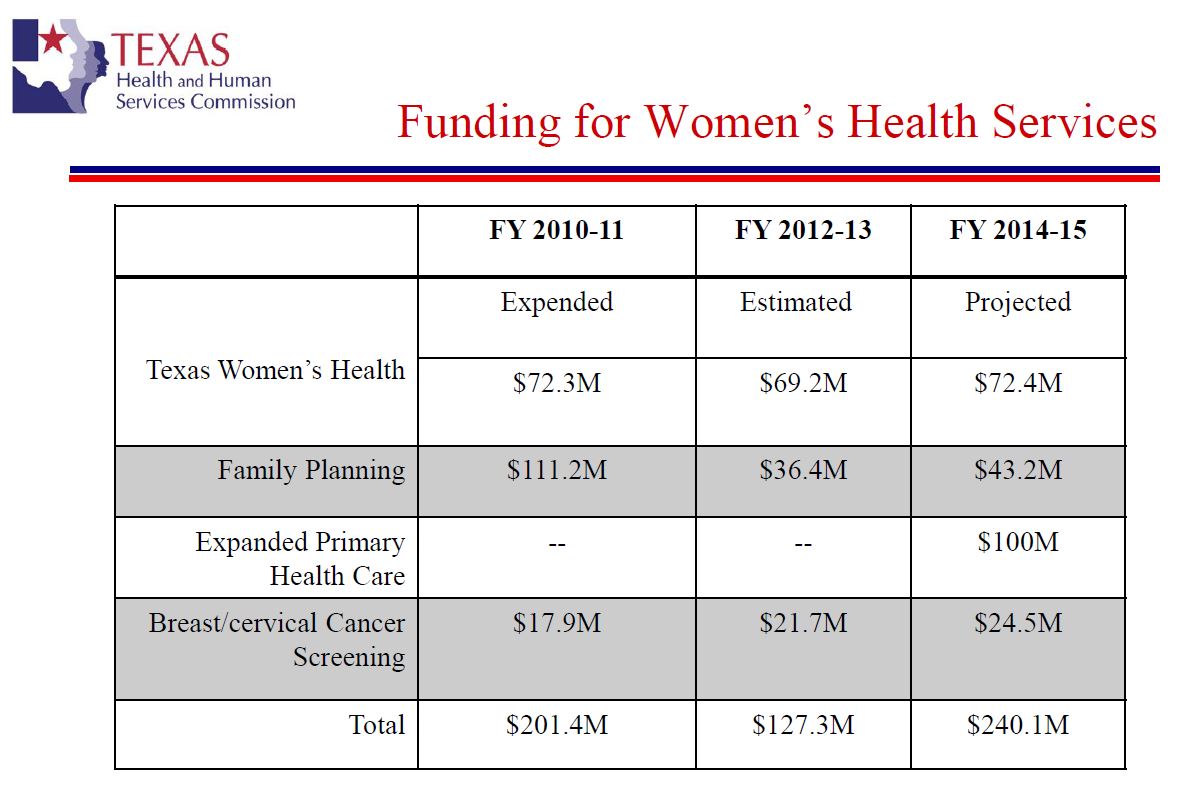

0214 hhscchartshowingwomenhealthspending2010-2015.JPG


SOURCE: “Presentation to Senate Committee on Health and Human Services: Texas Women’s Health and Family Planning Programs,” Feb. 20, 2014 (received by email from Joe Pojman, Aug. 6, 2015)


Other analyses support claim


Next, we asked the commission and outside experts about Pojman’s rally statement.


The consensus was that spending budgeted by lawmakers for 2016-17 would set a record, though some advocates cautioned this didn’t mean all needs would be met and others said that not all the described programs focus only on services typically provided by family planning clinics.


To our inquiry, the Texas Health and Human Services Commission emailed a more detailed chart basically lining up with Pojman’s recap. From the commission’s figures, it looked to us like the appropriated 2016-17 funds for women’s health services exceeded previous two-year expenditures by $40 million or more.


At the the Austin-based Center for Public Policy Priorities, which advocates for programs serving low-income residents, analyst Stacey Pogue said Pojman was on solid ground, though it’s complicated. For instance, Pogue said, the 2015 Legislature called for three women’s health programs to be reorganized in 2016 into two offerings overseen by the commission and precise spending results remain to be seen.


By email, Pogue pointed out a two-page summary of the 2016-17 state budget prepared by the Texas Women’s Healthcare Coalition, which says it promotes access to preventive health care for all Texas women “working toward the vision of a state where every woman has access to the preventive and preconception care that will help her stay healthy and prepare for healthy, planned pregnancies.” According to this June 2015 summary, $260.9 million in spending on women’s health care budgeted by lawmakers for 2016-17 reflected an increase of $46.5 million, or 22 percent, from what was budgeted for 2014-15.


We confirmed the latest figures in the 2016-17 appropriations act approved by a Texas House-Senate conference committee; it shows $130,321,510 in budgeted spending on women’s health services in the fiscal year beginning Sept. 1, 2015, and $130,548,682 for the subsequent year, totaling $260,870,192 in the biennium.


As noted by Pojman, the act also says that each year, on approval of the budget board, the commission shall allocate $50 million “providing primary health care services to women” including but not limited to preventive “health screenings such as breast and cervical cancer screenings, diabetes, cholesterol, hypertension and STD-HIV screenings; family planning services including contraception; perinatal services; and dental services.” Due to such spending, the act estimates that annually, 65,000 adults and adolescents would receive family planning services.


It’s that additional spending, the coalition summary indicates, that makes the budgeted spending higher despite legislated reductions in spending for family planning (a cut of $1.5 million, or nearly 4 percent) and the Texas Women’s Health program (a cut of $2 million, or 3 percent).


Alabama analyst


Also to our inquiry, Heather Busby of NARAL Pro-Choice Texas, which says it focuses on guaranteeing Texans the right to make personal reproductive health decisions including contraception and safe abortions, suggested we query Kari White, a University of Alabama at Birmingham professor and expert on women’s health issues who’s been part of a Texas-based team studying effects of the Texas decision barring aid to clinics affiliated with abortion providers.


By phone and email, White agreed the state has allocated what looks like a record level of money to the efforts singled out by Pojman though she speculated by email the spending bump might be less dramatic than available figures suggest. “The focus on funding allocated for the four programs on Pojman’s list,” White said, “does not entirely capture how some of the women’s health services historically have been paid for. For example, primary care services for women that are now covered by EPHC were previously paid for using other state-administered and federal programs (not included on Pojman’s list). By not factoring these programs into funding totals in previous years, the recent increase may seem larger than it actually is.”


Spending per woman


“Also,” White wrote, “funding allocations do not reflect how effectively these programs are serving women.  In other words, there may be more total dollars set aside for services, but since quite a bit of this new funding has been going to organizations that do not have a lot of experience with family planning, the state is spending more but not necessarily serving more women.”


White suggested we consider research by the Guttmacher Institute, a nonprofit that promotes reproductive health and abortion rights. In 2013, more than 1.7 million Texas women “were in need of publicly supported contraceptive services and supplies,” according to a July 2015 institute report that started from U.S. Census Bureau survey results. That year, the report said, publicly supported health centers provided contraceptive care to 281,170 women in Texas plus 47,390 teens. “These totals amount to substantial proportions–but not nearly all–of the women in need of publicly supported contraception,” the report said.


For our part, we asked the commission for help estimating the number of Texas women eligible for the health services. Could it be that even with spending up, less money is available per potential beneficiary?


By email, spokesman Bryan Black provided a chart, drawing on U.S. Census Bureau surveys, estimating the number of female U.S. citizens aged 15-44 living in Texas at or below 200 percent of the federal poverty level from 2010 through 2017–in other words, the women who most likely would qualify for the health services. Next, we calculated that some $109 per potential beneficiary was spent in 2010-11 and 2012-13; this was exceeded by the $205 per potential beneficiary appropriated by lawmakers for such programs in 2014-15 and the $236 per potential beneficiary appropriated for 2016-17.


Our ruling


Pojman said the state of Texas “is funding … women’s health services at historically high levels; they just increased their level another $50 million for the next two years.”


Texas lawmakers this year voted to appropriate more for women’s health services than before–including the $50 million bump.


This includes funding for general health services such as diabetes and cholesterol screenings. It also may be meaningful that programs are under reorganization. Too, lawmakers started putting more money on the table after their actions led the federal government to cut off tens of millions of dollars for reproductive services.


We rate this claim True.


TRUE – The statement is accurate and there’s nothing significant missing.


Click here for more on the six PolitiFact ratings and how we select facts to check.


Anti-abortion leader says Texas funding women"s health services at historically high levels

Dienstag, 1. September 2015

Eating healthily, less might lengthen lives, study says

(RNN) –  Healthy people who ate less food while getting essential nutrients improved their blood pressure, cholesterol and insulin resistance –   indicators associated with a longer life.


Researchers with the two-year National Institutes of Health study reached that conclusion. They studied 218 normal weight and slightly overweight young and middle-aged men and women who restricted their calories in comparison with 218 who ate their regular diets.


Encouraged by the results, published in the September 2015 Journal of Gerontology: Medical Sciences, a researcher added a note of caution.


“… We need to learn much more about health consequences of this type of intervention in healthy people before considering dietary recommendations,” said Dr. Richard J. Hodes of the NIH in a news release. “In the meantime, we do know that exercise and maintaining a healthy weight and diet can contribute to healthy aging.”


In laboratory animals, the researchers said, calorie restriction started in youth or early middle age usually increased life spans. In people, an equivalent trial would take decades.


“As we continue to try to unlock the mechanisms that make calorie-restricted animals live longer, we are certain that eating smaller portions of healthier food is a good idea for all of us,” said Dr. John O. Holloszy, the principal investigator at the study’s site at the Washington University School of Medicine.


Researchers had set out to test the effects of calorie restriction on the resting metabolic rate and body temperature, two factors proposed as affecting longevity.The study found a temporary, insignificant effect on resting metabolic rate and no effect on body temperature.


The calorie restriction participants lost an average of 10 percent of their body weight in the first year and maintained the weight over the second year. Researchers described that amount as “the largest sustained weight loss reported in any dietary trial in non-obese people.”


Compared to the control group, calorie restriction significantly lowered several predictors of cardiovascular disease, the NIH said:


  • decreased average blood pressure by 4 percent;

  • decreased total cholesterol by 6 percent;

  • increased levels of HDL (“good”) cholesterol; 

  • caused a 47-percent reduction in levels of C-reactive protein, an inflammatory factor linked to cardiovascular disease;

  • markedly decreased insulin resistance, an indicator of diabetes risk; and 

  • decreased T3, a marker of thyroid hormone activity, by more than 20 percent, while remaining within the normal range. Lower thyroid activity, the NIH said some studies suggest, may be associated with longer life span.


Although the study found no negative effects on mood (hunger-related symptoms), a few participants developed transient anemia and greater-than-expected decreases in bone density given their weight loss.


A researcher suggested a future study.


“It also would be useful to discover if calorie restriction over longer periods has additional effects on predictors of health in old age,” said Dr. Evan Hadley of the NIH, “and compare its effects with exercise-induced weight loss. “


Copyright 2015 Raycom News Network.  All rights reserved. 


Eating healthily, less might lengthen lives, study says

Freitag, 10. Juli 2015

Study Says Your Nose's Imagination Could Affect Your Weight


Researchers Want Closer Look At Schizophrenia-Smoking Link

Getty Images / Jeff T. Green


Researchers Want Closer Look At Schizophrenia-Smoking Link


James Holmes Says He Will Not Testify

Getty Images / Marc Piscotty


James Holmes Says He Will Not Testify


Bang, Bang! Alison Brie Hit The Mark On

Spike / ‘Lip Sync Battle’


Bang, Bang! Alison Brie Hit The Mark On ‘Lip Sync Battle’


The More We Learn About OPM Hack, The Worse It Gets

Getty Images / Mark Wilson


The More We Learn About OPM Hack, The Worse It Gets


Study Says Your Nose"s Imagination Could Affect Your Weight

Samstag, 6. Juni 2015

Chris Pratt Says He's Never Going to Be Fat Again

Regardless of your feelings on dadbod, you can’t deny that Chris Pratt looks great as of late. The Jurassic World star has shocked and awed fans with his significant weight loss. But in a recent interview with UK Men’s Health, Pratt explains why he had a little more to love in the first place:


“I put on weight because I’d fallen in love with a woman [Anna Faris] who loved to feed her man,” he told Men’s Health. “I was her little Hansel out in the woods and she was fattening me up to put me in the fire. It was like Momma Bear and Papa Bear. She would eat a little bit, I would eat all of mine and the rest of hers.”


But it didn’t stop there—Pratt gained weight on the set of Parks and Rec as part of running joke. “I wanted to get fatter for the role [of Andy],” he said. “I announced it to the whole cast, and then it became a bit of a game: how fat can I get and how fast.”


Pratt eventually figured that out, citing “real health issues” that were affecting him. “It’s bad for your heart, your skin, your system, your spirit,” he said.


Pratt had lost and put on weight for different roles, but once he saw himself in Zero Dark Thirty, he said he reached a point of no return: “I’d gone back and forth, lost weight for Moneyball, got fat again, then trimmed down for Zero Dark Thirty, then gained it all back again for Andy. That’s when I saw Zero Dark Thirty and right after walking out I was like: ‘I’m going to get in shape and I’m never going to be fat again."”


No more mama and papa bear. But for the record, we’ve always loved his look


Chris Pratt Says He"s Never Going to Be Fat Again

Dienstag, 21. April 2015

Topeka Birthing Center Says It Is Closer To Reopening


A Topeka women


Stay Connected Anywhere


TOPEKA, Kan. (WIBW) – A Topeka women’s health facility says it’s a step closer to delivering babies again.


Dr. Josie Norris told 13 NEWS the Birth and Women’s Center has reached a transfer agreement with Stormont-Vail Health Care and has submitted it to the Kansas Dept. of Health and Environment for approval.


The facility posted a similar update on its Facebook page on Tuesday. (See the post below or click here)


Stormont officials confirm they have reached an agreement and plan to issue a formal statement Wednesday.


The state issued an emergency suspension order in February, stopping delivery of newborns at the facility. The order cited concerns such as taking on high-risk patients and not transferring clients to other facilities when needed.


On Tuesday, a KDHE spokesperson said the center’s status is unchanged. She also could not confirm an agreement with Stormont, saying only any documents would need to be reviewed to ensure compliance and there was no timeline for completing that.


The center submitted a transfer agreement with University of Kansas hospitals in late March. However, the center said the state rejected it because of the distance between the facilities.


KDHE has the signed agreement from Stormont Vail on their desk this afternoon. We are hopeful that the suspension will…


Posted by Birth & Women’s Center on Tuesday, April 21, 2015


Topeka Birthing Center Says It Is Closer To Reopening